Thursday, December 24, 2009

Kuala Lumpur, Malaysia

Saturday, December 19th
Route of the Ancient Traders
Day 39
M/S Nautica
Kuala Lumpur, Malaysia
Showers - 86 Degrees

It was another rainy day in Malaysia, docked in Port Klang, 45 minutes outside of Kuala Lumpur.

Cyprus has one kind of divided capital, Nicosia split between Cypriot and Turkish control. Malaysia has another. KL remains the seat of parliament and the financial center of the country, but the seat of government and the Federal Administrative Centre were moved to the planned city of Putrajaya in 1999.

Kuala Lumpur would like to compete with its neighbor and former sister, Singapore, as a center of international commerce, but they aren't there yet. The heart of the city is Independence Square, the former playing field of the Royal Selangor Club. The bus, and the rain, stopped long enough for a visit to this civic square and festival grounds, but despite the moniker of grandeur, it's really just a muddy field.

Our tour of the city continued to the icon of modern Malaysia, the Petronas Towers. Completed in 1998, these were the tallest buildings in the world until Taipei 101 surpassed them in 2004, but they remain the world's tallest twin towers, connected by a sky bridge on the 41st floor.


The towers were designed by a team led by Cesar Pelli with traditional Islamic art and geometry, reflecting the Malaysian Muslim majority. A cross-section of the towers is a riff on the shape of the Rub el Hizb, an ancient symbol from Islamic literature.


The Petronas Towers represent a mid-point between the boxy sky scrapers of the American era of dominance, and the more graceful towers of modern international design, like the Burj Dubai. The towers eschew the "less is more" aesthetic for an elaborate, complex, highly adorned design. More solid than airy, but still full of character, the towers are both beautiful and beguiling, like a Malaysian woman shrouded in a burkha. The Petronas Towers are iconic, unrivaled as the symbol of Kuala Lumpur and vastly exceeding the fame of the oil company that is their primary tenant and namesake.

In the base of the Petronas Towers is the Suria Kuala Lumpur City Centre (KLCC), a modern six-level shopping mall. Yes, we came half way around the world to spend the afternoon...in a mall. But, few other malls in the world provide access to this kind of architecture. Besides, it's raining. What else were we going to do?


Finished exploring, we followed the longest line of locals to the most authentic lunch we could find. The reviews for Madam Kwan's are mixed and we are under no illusions that this represents the best of Malay cooking, but it was outstanding for mall food. The menu here is inspired by the "hawker" street food tradition in Southeast Asia. We started with very good spicy prawn stuffed crispy wontons. Chicken curry was spicy and rich, luscious dark meet in a mostly familiar curry with a hint of something we didn't recognize. The clear favorite was beef rendang, a sweet and flavorful pot roast braise of beef in coconut milk and spices. The liquids reduce as the beef falls apart resulting in a thick ragu of stringy-tender beef. Awesome!!! Char Kuay Teow was a late add to round out the meal, wet, flat rice noodles, stir fried with meat, scallions, and beans prouts.

KL wasn't exactly disappointing, but it wasn't inspiring either. The Petronas Towers set the tone, but the band hasn't fully formed. Not yet what it wants to be, Kuala Lumpur is still a work in progress.

Next Stop: Singapore, Singapore and Disembarkation

Penang, Malaysia

Friday, December 18th
Route of the Ancient Traders
Day 38
M/S Nautica
Penang, Malaysia
Thunderstorms - 87 Degrees

Penang is known as the Pearl of the Orient, which seemed appropriate this morning with rain so thick we felt like we were under water. I think we would have rather stayed in bed, but our bus awaited.

Even in the rain, the streets of Georgetown were full of people in motion as we drove to the Kek Lok Si Temple, the largest Buddhist temple in Southeast Asia. It is majestically situated on a hilly slope that commands amazing views over Georgetown. Built in tiers beginning in 1890, the sprawling "Temple of Supreme Bliss" is dominated by the magnificent seven-story Pagoda of Ten Thousand Buddhas and the enormous bronze statue of the Goddess Kuan Yin. The stepped temple complex also includes tranquil gardens, a turtle pond, and decorative shrines and sculptures.

When the bus came to a stop at the foot of the mountain, we looked through droopy eyelids and the steamy, rain-streaked, windows of the bus, up, up, up the hill at the glorious temple shrouded in semi-darkness, clouds, and sheets of rain. No way. We stayed in the bus. As our intrepid fellow travelers filed off the bus, Tres took pity on a pretty lady and loaned her his raincoat. We rode around the block and the bus parked on a side street to wait out the temple tour. The rain continued to fall, the locals undaunted. One little boy walking with his mother, stopped to pee in the open gutter. Our soundtrack for the morning was the worst of American easy listening from the 70s and 80s. Rain and bad music. Just like home. When we came back around to the base of the temple, the others re-boarded the bus, water cascading from every surface. The pretty lady returned Tres' coat, saturated, and a set of postcards so we would know what we missed. The temple was glorious in the pictures, of course they were taken in the glow of the sun.


Fear not for our souls, we had two more temples to go. Still in the rain, we stopped at a Thai Buddhist Temple that houses the 4th largest reclining Buddha in the world, and, across the street, an open-air Burmese Buddhist Temple with a lovely standing Buddha.


After another hotel buffet lunch (better than yesterday, great satays with chunky peanut sauce), we visited the Butterfly Farm. The landscaped gardens, ponds, and waterfalls are home to more than 100 species of butterflies flying freely within a natural habitat. The air was so thick with these fluttering panes of stained glass, you were almost afraid to breathe.


Leaving the butterflies safely behind inside the nets, we drove through the surrounding hills and countryside, small farms, and protected forest, to a local roadside fruit stand. Tres was tempted by the durian, but they wouldn't let him bring it back on the bus. Stinky fruit!!!

Next Stop: Kuala Lumpur, Malaysia

Phuket, Thailand

Thursday, December 17th
Route of the Ancient Traders
Day 37
M/S Nautica
Phuket, Thailand
Mostly Sunny - 86 Degrees

We began the final leg of our cruise journey through Southeast Asia today in Thailand. I have been here before, on the Insurance Tour of 1987, courtesy of Crown Life. Phuket is an island paradise in the South of Thailand. White sand beaches line the bathwater-warm shores of the Andaman Sea, with towering resorts rising above.

We headed off the island today, to one of the most beautiful places on Earth, Phang Nga Bay.

From the pier, we drove to the island's north end and then crossed to the Thai mainland via the Thep Krasettree Causeway. Our first stop was at a rubber tree plantation, where we learned how rubber is harvested and made into products from tires to condoms. We would not have chosen this destination, but it was interesting to see the rubber tapped like syrup from maple trees, coagulated, rolled flat, and left to dry in the sun. This plantation also offered animal tricks featuring elephant rides and monkey shows.

We drove on to Phang Nga National Park, where we boarded motorboats for a cruise through lush mangrove swamps and cliffs.


The boats here are really cool. Long and lean, they are powered by recycled truck engines, open to the inside of the boat. The captain moves the engine up and down on a fulcrum, lowering and raising the propeller into and out of the water on a long drive shaft. The engines roar like the piston boats from the glory days of the hydros.


The pale, milky-green waters give rise to more than 80 islands. These unique karst formations were created when a collision of great magnitude occurred over 300 million years ago, between the Indian subcontinent and mainland Asia. The force of the tectonic plates pushed and rotated what is now Thailand and Malaysia, forcing the limestone above the surface. Vegetation on the karsts has evolved to withstand long periods of dryness and an almost complete lack of soil. We floated in and around and through the islands, passing under the rock through natural caves.


We stopped for pictures at Kao Ping-Gan Island, where part of the James Bond adventure, "The Man with the Golden Gun," was filmed. To locals and tourists alike, the island is referred to as "James Bond Island."


We stopped at Koh Panyee, a small island with a picturesque village extending out across the water, resting precariously on small pilings. It is inhabited chiefly by Muslim fishermen who originally migrated from Indonesia. Cut off from the mainland and most modern amenities, this unique culture has existed for more than a hundred years. This should have been a great opportunity to experience local culture, but it was just another shop stop as we navigated a warren of narrow floating alleys lined by stalls hawking a variety of stuff.

We were looking forward to lunch at one of the resorts on Phang Nga Bay. We love Thai food!!! Unfortunately, our one meal in Thailand wasn't Thai at all. Bad American-Chinese sweet and sour, a couple flavorless stir fries, and deep-fried fish. The only note of authenticity was the Singha beer.

Back to the ship.

Next Stop: Penang, Malaysia

Tuesday, December 22, 2009

Crossing the Indian Ocean

Monday, December 14th - Wednesday, December 16th
Route of the Ancient Traders
Day 34 - Day 36
M/S Nautica
At Sea
Mostly Sunny - Low 80s

We enjoyed our final three days of luxury and leisure at sea, crossing the Indian Ocean. The seas gave us some pitch and roll from time to time, but the crossing was uneventful. I spent some time in the sun, but Tres stayed inside, and out of the humidity.

Dr. Doug Sturkey presented his last two lectures of the voyage:

"Sea Stories: Wreck of Batavia, Mayhem and Murder- Wholesale Murder Followed the Wreck of the Dutch Ship, Batavia, Off the Western Australian Coast."

and

"The Search for a Singapore - Raffles was Charged in the 19th-Century to Find a Place that Would Facilitate Britain's Asian Trade While Reducing Dutch Competition."

Doug's lectures, and his company aboard ship, have added a lot to the cruise experience. While each of these topics taken in isolation lacks context and a larger meaning, they have informed our travels and added some intellectual rigor to what has been a pretty cush trip. We are looking forward to reading his book when we get home, "The Limits of American Power: Prosecuting a Middle East Peace."

Tomorrow, we embark on the final leg of the cruise in Southeast Asia, then Hong Kong and the trip home.

Next Stop: Phuket, Thailand

Sunday, December 13, 2009

Cochin, India

Sunday, December 13th
Route of the Ancient Traders
Day 33
M/S Nautica
Cochin, India
Mostly Sunny - 92 Degrees

With one of the best natural harbors in the world at the Southern tip of the Indian Sub-Continent, Cochin is known as the Queen of the Arabian Sea. This is one of the most progressive, literate, and highly educated parts of India.

With all of that going for it, though, there is not much to see here.

We began our tour with a drive through the jungle to the Old Town. The center of life here was the Mattancherry Palace built in 1557 by the Portuguese. Most of the former glory of this building is long gone.


We proceeded to Jew Town, a neighborhood that was once exclusively Jewish. Now, there are just 12 Jews in the area, and a total of 47 in the region. Still, it is home to the oldest active synagogue in India.


Making our way closer to the waterfront, we visited St. Francis Church, the oldest European-Built church in India. It was built by the Portuguese in 1503, and held the remains of explorer Vasco de Gama, until he was exhumed and repatriated to Portugal.


This is Sunday morning and we arrived during mass. We tried to keep quiet until the power went out and they fired up an ancient generator in the back cemetery to restore the lights and ceiling fans.


Historically, Cochin survived on trade and fishing. The symbol and most enduring image of this community is the Chinese fishing net. They line the beach in both directions. These mechanized nets are lowered into the water during tide changes to trap large numbers of fish. They are at once beautiful and functional, graceful and powerful.


We continued our tour with a harbor cruise.


The major waterways are attracting major development. Condo towers lining the waterfront are home to middle class workers in the Indian tech sector and Arabian oil fields.


The "tranquil backwaters" of Cochin are home to lower-class families. The water here is used for transportation, cooking, drinking, cleaning, bathing, and waste disposal.

Everywhere we go in the world, people stare at Tres. It is just a fact of life. Differences attract attention. The curious stares of children are easily disarmed by a generous smile. In the United States, most adults have the courtesy to look away when caught staring. Those who don't are met with a glare and sheepishly relent. This is not the case in foreign countries where obesity is not yet an epidemic and Tres is not just at the very end of the spectrum, but a true outlier. Still, even in remote corners this is more curiosity than cruelty. Not in India. At each of the sites we have visited here, travelers from around the country have not only stared, but mocked and laughed and tried to take his picture. This breaks my heart and I know it hurts Tres as much as it enrages him. Since most Indians speak English, he has taken to explaining to them why this is rude and hurtful. Unfortunately, good manners are not the natural state of affairs and it's hard to fight human nature. We are lucky he hasn't killed someone. We consciously try to be respectful and open to new people and different ideas when we travel, but it is hard to enjoy the peace and serenity of the Taj Mahal or the beauty and perseverance of the Indian people when we are not accepted for who we are as well.

India has been an adventure. From abject poverty, unimaginable filth, overcrowding, illiteracy, and British Colonial Rule in the North, to subsistence, sanitation, sustainable population, literacy, and Portuguese colonial rule in the South. From inspirational monuments and significant historical sites to more humble destinations. India is said to have more billionaires than any other country, and probably more people in desperate poverty as well. Our time here has changed our perspective on the world and redefined our understanding of the gap between rich and poor, clean and unclean, developed and developing. They have a long, long, way to go.

Next: Crossing the Indian Ocean

Mangalore, India

Saturday, December 12th
Route of the Ancient Traders
Day 32
M/S Nautica
Mangalore, India
Mostly Sunny - 94 Degrees

We docked this morning at the Port of Mangalore, an industrial port at the confluence of the Netravati and Gurupura rivers. This region of India exports vast quantities of iron ore, but there is not a lot to see in Mangalore.

India is a multi-ethnic and multi-religious society. The vast majority of Indians, more than 80%, are Hindus, but many other religions are represented and make valuable contributions to the culture, including Islam, Christianity, Sikhism, Buddhism, and Jainism. These are all religions we know well, or at least know of, except maybe for Jainism.

Jainism is an ancient dharmic religion that prescribes non-violence for all forms of living beings. Each individual is responsible for advancing their soul on the spiritual ladder to divine consciousness. Any soul which has conquered its own inner demons and achieved the state of supreme being is called Jina.

Mangalore is a launching point for a Jain pilgrimage and we are hoping to make our own progress toward Jina today.

The jungle in Mangalore is lush and the road going through it is hilly, curvy, and rough. Traffic was thick and the road was narrow. We would accelerate up a hill, only to round a bend and come to an abrupt halt as we met oncoming traffic. We were in the back of the bus - up, down, left, right, start, stop... We finally arrived at our first stop looking green, and it was all up hill from there.

Karkala is the site of a monolithic stone statue dedicated to Lord Gomateshwara of the Jain faith. It is one of the largest monolithic statues in the world at 42 feet tall, weighing in at 80 tons. It was erected in 1432 atop a huge granite rock, 212 steps from ground level. The effort it required for Tres to climb to the top in 90 degree heat and 90 percent humidity was second only to the effort it must have required to haul the statue up there in the first place. But we made it, and felt small standing at the feet of the God.


Our next adventure was more refreshing. We made a stop at Soan's Farm, founded in 1926 by a Swiss-German missionary society, and known for innovative agriculture. They greeted us with fresh, cool pineapple juice, the sweetest we had ever tasted. We had a tour of the farm, and then left to continue our Jain pilgrimage.


Moodbidri is home to the 1,000 Pillar Temple, Tribhuvana Tilaka Chudamani Basadi. Built in 1430, this is the largest and most ornate of the Jain temples in the region. No two columns are alike. We didn't count, but we think 1,000 is a major stretch.


We got back on the bus for the wild and windy drive back to the ship. On the way, we passed a massive garbage dump extending for acres in both directions from the road. There is an incineration plant here, but the backlog must be measured in years. It will take an act of God, maybe the end of the world, to burn off the refuse. The stench invaded the bus and was slow to leave. It made the bumpy ride that much more stomach-churning, but we were thrilled to have passed this way. It was our only indication in our travels through India that any garbage has ever been collected and removed.

Next Stop: Cochin, India

Saturday, December 12, 2009

Agra, India

Thursday, December 10th - Friday, December 11th
Route of the Ancient Traders
Day 30 - Day 31
Overland
Agra, India
Mostly Sunny - 88 Degrees

Thursday, December 10th
Day 30

As we awoke at 5:30 for a sunrise visit to the Taj Mahal, the wedding from the night before was still going strong. We admired their stamina as we stumbled around the room.

It was the same procession of chaos to get to the Taj, but the gauntlet was quieter. The shops were just starting to open, the shopkeepers burning fires of dung out front to bake their bread and heat their tea for breakfast. A paperboy made his deliveries and we stood in line waiting for the gates to open.

Much is made of the transformation of the Taj by changing light throughout the day, but the pollution serves as a consistent filter, obscuring the impact of the light. Nevertheless, sunrise at the Taj Mahal is a magical time. The monument is shrouded in mist and there are very few people to compete for the views. This is the peace that we have come here to feel.


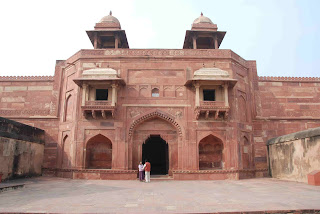
Later in the morning, we drove out into the Indian countryside to visit Fatehpur Sikri, the red sandstone former capital of the Mughal Empire. It is accented with the inlaid white marble perfected on the Taj Mahal and has Jain, Hindu, and Islamic influences. Here, Emperor Akbar ruled with his four wives, each with her own mosque and living quarters. This sprawling hill-top palace was completed in 1571 and abandoned just 14 years later. The water supply dried up and draught forced the capital to move.


In the afternoon, we paid a visit to the Tomb of Itmad-ud-Daulah in the old city of Agra. Itmad-Ud-Daulah was the first Mughal structure totally built from marble and pioneering the extensive use of "pietra dura," the inlay work so characteristic of the Taj Mahal.


Friday, December 11th
Day 31


This morning we visited Agra Fort, another World Heritage Site credited to Emperor Akba, India’s great visionary. This was the seat of the Mughal Empire in Agra.


The artistry and the engineering here are amazing. The fort was constructed with red sandstone and accented with white marble, some of it carved so delicately that it looks like stained glass as sunlight shone through. An intricate drainage system throughout the fort collected rainwater for drinking, irrigation, reflecting pools, and fountains.


Ironically, Emperor Akba was deposed by his son and imprisoned in a tower here with a view of the Taj Mahal and his fallen bride.


Our charter to Goa was delayed by smog and air traffic above near-by Delhi, but we finally got off the ground in another Kingfisher Airlines A-320. Supposedly we won the business class seats in a drawing, but we suspect that our friend the ShoreEx Manager Nicki may have helped us out.

Goa, India

We were met at the airport and loaded onto buses for a late tour of Goa. As we pulled out of the airport onto the road, traffic conditions were more of the same, only worse. They say the roads are under construction; they are widening to four lanes. Things must be getting worse before they get better. In Goa, there is a saying, "In the rest of India, they drive on the left of the road. In Goa, we drive on what's left of the road." Brilliant!!!

Traffic in Goa was no better, but the standard of living was markedly different. The climate here is tropical and the land is jungle-like. The population is much lower, the literacy rate is higher, and the Portuguese seem to have left a better legacy in the South than the British did in the North.

We rode through the jungle to Old Goa to see the Basilica of Bom Jesus, famous throughout the Catholic world as the home of the remains of the missionary, St. Francis Xavier. It is said that his remains never decomposed.


He is on display in a side chapel and there is a window into his coffin. Every ten years, they take him down from the alter so pilgrims and get a closer look. This last happened in 2004 and more than two million people came to view the spectacle.


We Continued on to Panjim, the capital of the region. This is a modern beach resort and governmental center with Portuguese-style winding streets and old houses with red-tiled roofs and overhanging balconies. It is one of India’s smallest and most pleasant capitals and the only thing close to charming we have seen in India.

It was another rough and winding drive back to the ship.

Next Stop: Mangalore, India

Mumbai, India

Wednesday, December 9th
Route of the Ancient Traders
Day 29
M/S Nautica
Mumbai, India
Mostly Sunny - 88 Degrees

We docked in Mumbai this morning to thick, choking smog and humidity. Our eyes, throats, and lungs immediately began a slow burn that would not let up for the rest of our time in India. The air has an acrid sweet and sour smell. Predominantly exhaust and wood smoke, but with hints of curry and diarrhea. We could see very little through the muck from the decks of the ship, but we could hear the band on the dock welcoming us to India. As we walked out on deck and down the gangplank, they played Europe's "The Final Countdown." Classic!!!

Indian immigration officials greeted us for another face-to-face passport check. This time, they stamped our passports and gave them back to us to carry ashore. Apparently, immigration officers have been busy with our passports in previous countries as well. Tres was pleased to discover stamps from Jordan, Oman, and the UAE. Wooo-hooo!!!

The Indian government has initiated a program of re-branding throughout the country. They are eschewing foreign colonial names for more authentic Indian monikers. In 1996, Bombay became Mumbai. Bombay was a Portuguese name meaning "good or small bay." By law, Mumbai must be used in all official business, but the people still refer to home as Bombay.

Mumbai is on the West coast of India centered between the North and South. Nautica will remain docked here overnight, departing late tomorrow, arriving in Goa on Friday. We are flying to Agra in the North to visit the Taj Mahal and will rejoin the ship Friday evening in Goa, before proceeding down the coast to Mangalore and Cochin.


We drove through the port area into downtown Mumbai at about 9:00 in the morning. The commute was winding down, but there was life everywhere. Pedestrians, bicycles, mopeds, scooters, motorcycles, motor-rickshaws, taxis, cars, trucks, goats, cows, water buffalo, dogs, sheep, etc. Total chaos. Traffic laws are merely suggestions in India, and no one seems to take the hint. Traffic of all kinds moves every which way at all times. As our guide said, red and green traffic lights are really just Christmas decorations. They drive on the left here, but just barely. If there is no median, you are welcome to use the whole road, which is often only one lane anyway. Passing is always a close call. The bus driver has an assistant that actually walks out into traffic to move this or that out of the way so the bus can proceed.

We passed historic Victoria Station.


Throngs of people teamed out of the exits like steam escaping from a boiler. They spilled out onto the streets fanning out in all directions, crossing streets mid-block, waiting for buses, catching taxis. The taxis are a riot. Every bit as ubiquitous and iconic as the taxis in London, Mumbai taxis are ancient Fiats with meters on the outside. They are tiny little clown cars, but they say that there is always room for one more passenger inside. Every vehicle with a horn uses it. Short honks are used as greetings and they get longer as frustration builds. The animals have the right of way, and they know it. We were told that water buffalo will respond to horns and move, while the cows have some understanding of their sacred place in Hindu society and don't respond to anything less than a gentle shove.

The filth and poverty tour has resumed after a brief respite in oil-rich Arabia. It is immediately clear that we have gone from one of the richest places in the world, Dubai, to one of the poorest, Mumbai. The squalor is really indescribable. Even in the commercial center, the buildings are rundown in the way of many abandoned colonies. They were built by the wealth of other nations and then left to rot. Little shantytowns pop up everywhere. Homes and business crammed together in row after row of ramshackle salvage. It is hard to believe people live this way. But, for all the misery, the people don't seem to notice. They are well-dressed and going about their business with purpose and dignity.

We made our way through the city and down to another part of the waterfront. There is an ancient Mosque at the end of a causeway that is only accessible outside of monsoon season and at low tide. We continued along the "Bombay," the haze still too thick to see beyond the rocks, until we came to the Sea Link, bridging the bay with a toll span. As we turned back, we had a view of the city through the smog. There are a few modern towers, but our last look at Mumbai was the ancient fort at water's edge, surrounded by another slum.

The domestic airport is in a suburb of Mumbai. Near the airport we passed the slum made famous by the movie, but it was all "Slumdog," and no "Millionaire." We pulled up to the departure terminal dreading what was to come. Indian security is notorious for being difficult to navigate, especially since the terror attacks by Islamists from Pakistan beginning November 26th, 2008. After four days of bombings, 173 people were dead and 308 wounded. This was India's 9/11. The attacks were all over the news again as they marked the one-year anniversary last month. Security was thorough, but relatively easier than US security. We breezed through the checkpoint and down an escalator to the gate where our charter was waiting.

We boarded a Kingfisher Airlines Airbus A-320 and took our seats in business class for the 2 hour flight to Agra. The plane was new and comfortable and the trip to Agra was uneventful. This is a joint civil and military airport with armed guards standing watch as we descended the stairs onto the tarmac, through the terminal, and onto the buses.

Agra was the capital of the Mughal Empire and was once a great city. There is lots of history here, and many monuments. The Taj Mahal is just the beginning. Outside of the gates surrounding these amazing relics, modern Agra is just one never-ending slum. Agra is just the third most populous city in its state, with a population of 1.5 million people. They all seem to live in filth and squalor. Driving down the road in the middle of the city, all forms of human activity take place in full view. People on their way to and from work and school, transporting goods, just hanging out, urination, defecation, washing, eating. The animals that wander free are thin and sickly. Dung is collected and sold for fuel. Garbage piles up in every low place. The conditions here are as bad as you can imagine, and worse. And yet, as overwhelming as the grime and hopelessness appears, the dignity of the people is even more so. Their clothes are clean and pressed, especially the uniforms worn by the school children. They sweep dirt floors with brooms homemade from twigs. They offer no apology for the way they live. Nor do they wallow in their misery or begrudge us as we pass. They wave and welcome us, proud of what they have and what we have come to see.

We checked into the Gateway Hotel and our room on the fourth floor with a view of the Taj. Comfortable beds and solid plumbing, luxuries the locals couldn't imagine.


After a rest, we departed for the Taj Mahal nearing sunset. We took buses to a parking lot where we transferred to electric buses for the final leg to the monument. This was a concession to concerns about the effects of pollution on the Taj, a noble idea, but a total joke. The electric buses don't make a dent in the pollution that obscures the hand in front of your face, let alone the monument. The electric buses dropped us off at the foot of the gauntlet. The grimy street was lined with souvenir stands and hawkers pushing their wares. They are in your face the whole way, but you have to ignore them. We made it to the East gate and got in line for security. Once inside, we emerged into a large courtyard where people entering from the other gates converged on the main entrance to the Taj. Inside the entrance, the vista opened up. A series of long landscaped reflection pools lead to the Taj Mahal. It is flanked by mosques on each side and sits above the Yamuna River to the rear. It is an awesome sight.


The Taj Mahal is a mausoleum and a monument to Mumtaz Mahal, beloved wife of Shah Jahan. The couple were inseparable. Mumtaz Mahal accompanied Shah Jahan on all of his travels. In 1631, she joined him on a trip to the South of India. She went into labor and died during the birth of their 14th child. Shah Jahan was shattered. The royal court was in mourning. For two years, there was no music, no feasting, no celebration of any kind. When Shah Jahan finally came out of mourning, he vowed to build a memorial to her that the world would never forget. Construction on the Taj Mahal began in 1633 and took 17 years and the labor of 20,000 craftsmen. The Shah was deposed by his own son in 1658 and lived the remainder of his life imprisoned in Agra Fort with a view of the Taj Mahal and the love of his life. In memory of his wife, Shah Jahan has given us perhaps the most perfect architectural and artistic achievement of all time. The white marble tiles are sculpted with carvings and reliefs, and inlaid with semi-precious stones an inch deep.


Many veterans of Indian travel have recommended that we eat vegetarian on this trip. Many Hindus are vegetarian and avoiding meat cuts down on the risk of getting sick. We love Indian food and have been looking forward to eating our way through vegetarian curry buffets. The food at the hotel was excellent. Every meal, even breakfast, included fresh-baked Indian breads and a selection of curries, like aloo gobhi, dal masala, paneer makhani, aloo bhaji, paneer hara pyaza, aloo capsicum, dal tadka, and many more. The heat was toned down to protect sensitive American palates, but the flavors were authentic. Tres had a field day!!!

After a flavorful dinner and a long day, we went up to bed. The party outside was just getting started. According to the astrologers, this is a favorable time for marriage. The hotel hosted a wedding that lasted all night. The parade went for miles down the street in front of the hotel with the bride and groom riding elephants. When they arrived, the reception moved to the back of the hotel. The music was beautiful and exotic as we drifted off to sleep.

Next: More of Agra